Has your excavator or loader gradually lost its former vigor over time? Performance degradation, increased fuel consumption, and frequent breakdowns often trace back to one core component—the hydraulic pump. Selecting the right hydraulic oil pump for your construction equipment isn't just about buying a part; it's a critical investment in your machinery's productivity, efficiency, and lifespan. A wrong decision can lead to thousands in losses and severe project delays. This ultimate guide will walk you step by step through all the essential knowledge needed to make the most confident and informed purchasing decision for your specific equipment and application.
1.Hydraulic Pump Principles: Type and Operation
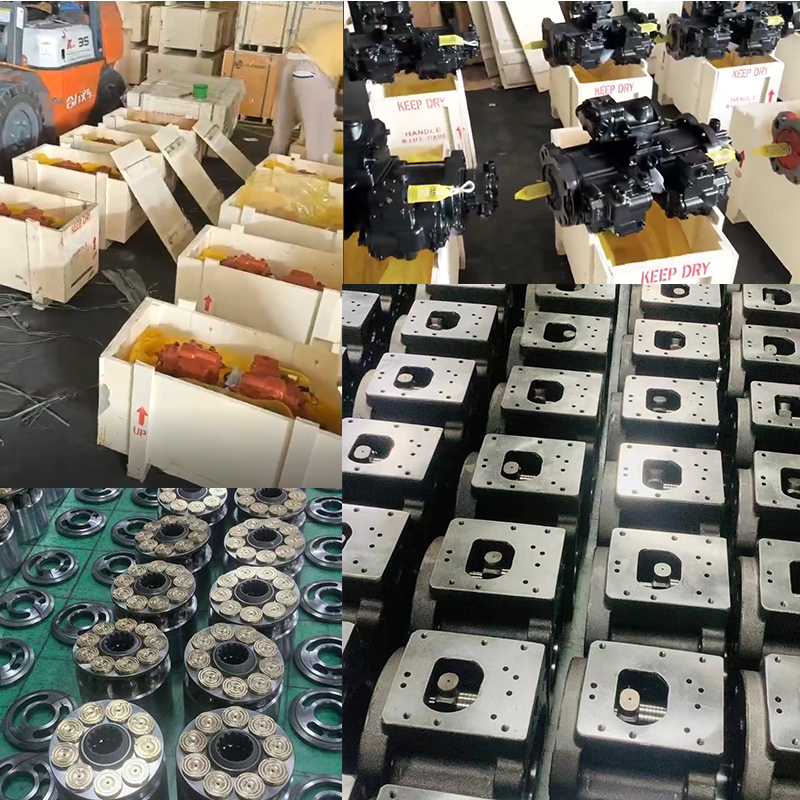
First we should understand what is a hydraulic pump and how does it work. In simple terms, hydraulic pump is the heart of hydraulic system. It is a mechanical device that translates mechanical energy (normally from an engine or motor) into hydraulic energy by creating flow with enough pressure to overcome the load pressure, permitting to operate cylinders and hydraulic motors and make your robotic arm dig, lift and move.
The principal three types of hydraulic pumps in construction equipment are:
How It Works: Two meshing gears—a main drive gear and a secondary driven gear—spin within a sealed chamber to move fluid.
Advantages: Simple construction, low cost, long life, not sensitive to burning of oil.
Disadvantages: Less efficient and less pressure capable compared to the three types; makes more noise.
Application: Known for low pressure demanding systems including warehouses, minor forklifts and coolings.
Hydraulic Vane Pump
Working Principle: Vane blades slide in and out of the rotor slots as they are carried around by the rotation of the rotor.Under centrifugal
forces, they are tightly pressed against the inner surface of the stator, moving fluids through volumetric displacement.
Benefits: Constant velocity flow, low noise and better volumetric efficiency than gear pump.
Cons: Needs stronger fluid clean-ness and can not resist as much pressure as plunger pumps.
Applications: Injection molding machinery, machine tools and other medium pressure industrial systems.
Plunger pumps can be also subdivided into radial plunger pumps and axial plunger pumps.Click for more.
The principle of operation:To exploit the piston ’s reciprocating motion in the cylinder to suction and discharge the hydraulic oil.
Advantages:Best efficiency, highest pressure capability, long life, and also displacement variable.
Disadvantages:Complex construction, expensive to manufacture,periodic replacement of oil is needed due to extremely stringent oil cleanliness
requirements; oil replacement immediately upon contamination.Typical
Applications:High-pressure, severe duty applications like excavators, concrete pump trucks, cranes, and just about every heavy-duty construction
machine you can think of.
2.Factors for core selection: five essential criteria
During the hydraulic pump selection process, the accuracy can be guaranteed because there are only 5 main parameters needed to be considered:
Working Pressure:Units are in Bar or PSI. This is the maximum pressure the pump is able to withstand.When choosing a pump,you need that the rated pressure of pump should be higher than that of working pressure of system slightly to meet the working condition.Plunger pumps are generally preferred for high pressure.
Displacement and Flow Rate:Displacement (cc/rev): It is the volume of fluid delivered in each revolution of the pump which dictates actuator speed. Flow rate (L/min) = displacement × rotational speed. Displacement too large or too small for application, making the machine run too fast or too slow.
Rated Speed range:The speed range Allowable for normal operation of Pump. Must>matchy~ your~ equipment's engine speed.
Efficiency:A multivariate performance indicator involving volumetric efficiency (internal leakage) and mechanical efficiencyThe volumetric efficiency (v) for a pump is the actual flow rate {Qa) divided by the theoretical flow rate (Qt). Premium Efficiency pumps (premium plunger pumps) conserve fuel and minimize heat generation.
Fluid Type and Viscosity Grade:Type of pump should be suitable for type and viscosity of hydraulic fluid. Wrong fluid choice can quickly lead to pump wear and ultimate failure.
3.Application Scenario Coordination: Selecting your Equipment and the Appropriate Pump Type for Your Application
Various types of construction equipment and work need different types of pumps with different features. Here is a Quick Cheat Sheet:
| Equipment/Application | Recommended Pump Type | Reasoning |
| Excavator (Main System) | Variable Displacement Piston Pump | Delivers high-pressure capability and automatically adjusts flow based on load demand, achieving exceptional energy efficiency and precise control. |
| Loader (Steering System) | Gear Pump or Load-Sensing Vane Pump | Gear pumps offer economical reliability; load-sensing pumps provide smoother, more efficient steering performance. |
| Small Forklift | Gear Pump | Economical and adequate for the raising and tilting duties. |
| High-Pressure Concrete Pump | High-Pressure Variable Displacement Piston Pump | The only one that can produce the extremely high pressures needed to pump concrete. |
| Mobile Generator Set | Compact Internal Gear Pump | Compact design delivers reliable performance in space-constrained cooling systems. |
4.Cost Control: Total Cost of Ownership Aspects
The lowest-cost pumps usually end up costing the most. Savvy consumers think about the cost of ownership, and that includes:
Initial purchase cost
Energy consumption costs (high-efficiency hydraulic pumps result in substantial fuel savings)
Maintenance and repair cost (durability, spare part price)
Cost of downtime (pump failures delay projects, and the losses are considerable)
While buying a good quality, high efficiency pump can be a higher initial cost, there is no question that it is always a wise investment as that will mean
lower running costs and less down-time.
5.Day-to-Day Maintenance and Common Problems Solutions
Right maintenance could make the hydraulic pump’s service life to be multiplied by several times. Here are a few typical
issues and some critical maintenance areas:
Problem: Excessive Pump Noise (Cavitation)
Potential Causes: Blocked inlet line, blocked return line, an energy source line (pressure line) to the Y yourn door, hydraulic oil filer is blocked, oil is too viscous, there is not enough oil.
Action: Check the oil level; clean or change the filter element; use the desired viscosity hydraulic oil.
Problem: Output pressure too low
Possible Reasons: Internal wear of the pump (due to reduced volumetric efficiency), wrong setting of the safety valve and malfunction of the valve.
Solutions: Check the pump output. If necessary, repair or replace. Service the pressure control valve.
Basics for daily service:
Keep the Oil Clean:Change the hydraulic oil filter frequently––this is the most important step in maintenance.
Watch Oil Temperature:High oil temperatures (usually above 80°C) speed up fluid and pump break down.
Check oil level and quality regularly:Change fluid immediately if emulsification or extreme contamination is found.
Don’t Overload:Run the machine within rated conditions of use.
Conclusion
Choosing a hydraulic pump for your construction equipment is a technical and strategic decision. Learn about the various pump types, important performance parameters, as well as your application requirements to help you become a value focused product buyer. Keep in mind, the best pump not only keeps your job running, but also is vital to the protection of your equipment assets. If you have any questions about certain models, do not hesitate to consult us—we will be happy to provide you with solutions.
FAQ
Q1: What are the differences between gear, vane, and piston pumps?
A: The major distinc-tions are in construction, pressure rating, and efficiency. Gear: easy and cheap to make simple gear pumps are used for low to medium pressure applications;
vane pumps are more smooth and they are used for medium pressure; piston pumps are complicated and they are very expensive , but they can provide the highest pressure and efficiency and they are widely used in
heavy duty construction machinery. You can find a more detailed explanation in [Part 1: Hydraulic Pump Fundamentals].
Q2: How can I choose the right operating pressure and flow rate for my excavator?
A: Operating pressure depends on the maximum force needed to perform work, such as digging or lifting, which should be obtained from the equipment manufacturer's technical document. Flow rate governs speed of movement and must also be converted to the rotational speed of the prime mover. Our [Part 2: Core Selection Factors] lays out how to calculate these the parameters.
Q3: What are the reasons my brand new hydraulic pump is so loud?
A: High noise levels in new pumps are reported to be related to cavitation (air in the oil) or to blocked inlet lines. Check the hydraulic oil level, the inlet filter and, check that all lines are clear. For more troubleshooting advice, see [Part 5: Common Troubleshooting].
Q4: What should I consider when selecting between fixed and variable displacement pumps?
A: Go with a fixed-displacement pump if you are on a budget and your equipment needs a constant flow. Opt for a variable-displacement pump if your equipment must operate at varying speeds under different operating conditions (e.g., Excavator Positioning Movements vs. High-Speed Rotation). This yields much better energy efficiency and control-precision, as described in [Part One] with regard to the piston pumps.